US digital marketing agency Tinuiti recently released its 2026 Holiday Shopping Trends report. The report focuses on consumers' holiday spending plans, shopping timing, shopping channels, factors influencing purchase decisions, and post-holiday consumption trends, with special attention to differences across age groups in budget and consumption preferences.

1. Consumer Spending Plans
Despite years of inflation and recent gasoline price increases, US consumers' sentiment about their financial situation has softened, yet holiday spending plans for 2026 have not contracted significantly and are still expected to grow moderately overall.
The survey shows that 27% of holiday shoppers expect to spend more on gifts this year, 23% expect to spend less, and 50% expect to stay roughly flat. In other words, while financial pressure persists, most consumers are not sharply cutting their holiday budgets.

Looking at online versus offline channels, consumers' expectations for online shopping are clearly more positive: 31% of respondents expect to increase online shopping this year, versus 24% expecting to increase offline shopping.
This means that even as consumers pay more attention to price and budget, online channels are likely to absorb more holiday demand. For brands, holiday shopping is no longer just a battle of physical stores and traditional promotions; competing for consumers across online retail, search, social media and e-commerce platforms matters just as much.
Meanwhile, "buying a gift for yourself" is becoming part of holiday spending. 31% of respondents plan to buy gifts for themselves this holiday season, including 42% of Gen Z and millennials, compared with 22% of Gen X and older consumers.
Looking at younger consumers' specific choices, 42% of Gen Z plan to buy children's gifts this year, slightly higher than the 41% buying gifts for themselves; among millennials and older consumers, 64% plan to buy gifts for their children.
There is a clear link between consumers' feelings about their finances and their holiday spending plans. Overall, 37% of respondents say their financial situation is worse this year than last — the most common answer — while only 29% say it has improved. Among those who feel worse off, only 15% plan to increase holiday gift spending, while 41% plan to cut back.

This shows that the overall holiday spending picture has not weakened sharply, but that does not mean every consumer is raising their budget — some will still cope with financial pressure by trimming gift spending.
Financial expectations also differ clearly by age group. 49% of Gen Z and 35% of millennials believe their finances are better than last year, versus only 22% of Gen X and 18% of baby boomers. Driven by more positive financial expectations, Gen Z is also the most likely group to say they will increase holiday spending this year, at 46%.
That said, although Gen Z is more inclined to spend more, their absolute expected budgets are not high: only 36% of Gen Z expect holiday spending above $250 this year, versus 51% of millennials, 44% of Gen X and 53% of baby boomers. This suggests younger consumers may be more willing to buy more often or across more categories, but it does not mean they have larger per-purchase budgets.
Whether shoppers need to buy children's gifts also significantly affects overall holiday budgets. Among those planning to buy gifts for children, 55% expect to spend over $250, versus only 34% of those who are not.
Even within Gen Z, 40% of those planning to buy children's gifts expect to spend over $250, compared with only 30% of those who are not. Children's, toy and infant products are therefore likely to remain an important holiday spending category.

By gift category, toys, children's and infant products rank third at 41% of purchase plans, behind apparel, footwear and accessories at 62% and gift cards at 55%.

Preferences differ noticeably by age. Gen Z and baby boomers are fairly close in buying apparel and toys as holiday gifts, but baby boomers are much more likely to buy gift cards (63% versus 48% for Gen Z). 48% of Gen Z consumers expect to buy video games or in-game currency as gifts, versus only 13% of baby boomers.

2. Consumer Shopping Timing
2.1 Nearly One in Five Consumers Has Already Started Shopping
The 2026 holiday shopping cycle continues to start early. The survey shows that 17% of consumers have already started buying holiday gifts, and another 14% plan to start before October. Although consumers are entering the holiday shopping phase earlier, Black Friday remains an important milestone. This year Black Friday falls on November 27, and 18% of respondents plan to begin their holiday shopping on that day.
In detail: 17% of consumers have already started shopping, 14% plan to start in August or September, 16% choose October, 18% plan to start between November 1 and November 25 (before Thanksgiving), 2% on Thanksgiving (November 26), 18% on Black Friday (November 27), 7% on the post-Thanksgiving weekend (November 28-29), 1% on Cyber Monday (November 30), and 6% plan to wait until December.

Different age groups have different shopping rhythms. 18% of millennials and younger consumers have already started shopping, versus 16% of Gen X and older — a small gap. But younger consumers are more likely to wait for Black Friday: 24% plan to start that day, versus 14% of Gen X and older.
Conversely, Gen X and older consumers are more likely to start in October (20%), versus 12% of Gen Z and millennials.
2.2 Black Friday to Cyber Monday Remains the Peak Window
The data shows that 29% of respondents plan to start buying gifts between Thanksgiving and Cyber Monday, including 34% of Gen Z and millennials and 25% of Gen X and older. This shows that while the shopping season is shifting earlier, Thanksgiving, Black Friday and Cyber Monday remain important concentrated spending nodes.
Consumers do not concentrate all their shopping after Thanksgiving. 14% say they will do no holiday shopping before Thanksgiving, 40% will complete "a little," 19% "about half," 15% "most," and 5% "all," with 7% undecided.
Between Thanksgiving and Cyber Monday, only 7% say they will not shop at all, 40% will complete some, 20% about half, 20% most, and 5% all, with 8% undecided. In other words, 25% of consumers expect to complete most or all of their holiday shopping in the five days from Thanksgiving to Cyber Monday, versus only 20% doing so before Thanksgiving.
This gap shows that although holiday shopping has clearly shifted earlier, the Black Friday promotional window and the weeks around it still have strong concentrated purchasing power. For brands and retailers, planning early does not mean ignoring the core promotional period in late November; a smarter approach may be to extend holiday marketing from a single Black Friday moment to a longer shopping cycle.
3. Consumer Shopping Channels
3.1 In-Store Shopping
Although online shopping continues to grow in importance, physical stores remain consumers' first discovery channel for holiday gifts. 45% of respondents say they discover holiday gifts through in-store displays or signage — the highest of any channel.
At the same time, search engines, social media and online shopping platforms form a second tier, at 37%, 36% and 33% respectively. 28% of consumers still discover gifts through television, 19% through catalogs, and 18% through streaming video services.

This shows that the consumer holiday path has not fully shifted from offline to online; in-store displays, search, social media and e-commerce platforms run in parallel.
Channel differences across age groups are especially pronounced. 55% of Gen Z discover holiday gifts through social media, far above the 36% overall average and 24% for baby boomers. Online shopping platforms reach 40% among Gen Z, above 33% overall and 28% for baby boomers.
By contrast, 48% of baby boomers discover gifts through in-store displays and 40% through search engines, both higher than Gen Z's 43% and 34%.
There is also a clear generational divide between traditional TV and streaming. Overall, 28% of consumers expect to discover gifts through traditional TV, higher than 18% through streaming video.
But the opposite is true for Gen Z: 33% plan to discover gifts through streaming video, versus only 26% through traditional TV. As younger consumers become a major holiday spending group, the role of video content — especially streaming — is likely to keep expanding.

3.2 Social Platform Shopping
Among specific social platforms, Facebook remains the most-used source of holiday shopping inspiration, at 52%; YouTube follows at 45%; TikTok ranks third at 36%, slightly ahead of Instagram at 33%.

Notably, TikTok's influence is not limited to Gen Z. Among millennials and Gen X consumers, TikTok also surpasses Instagram as an important source of holiday inspiration; baby boomers choose Instagram more often. Short-video platforms' shopping influence across age groups is no longer confined to the youngest consumers.
Influencer recommendations are also strongly linked to purchase behavior. 30% of respondents say they have bought a holiday gift because of an influencer recommendation: 52% of Gen Z, 40% of millennials, 26% of Gen X and 12% of baby boomers. Younger consumers are not only more likely to discover products through social media, but also more susceptible to social content and influencer recommendations.

Social media is also a key channel for finding online promotions and discounts. 38% of respondents look for deals on social media, including 50% of Gen Z. Search engines remain the main channel for deal information: 44% of consumers search for promotions and discounts; 34% get this information by email.
In addition, browser extensions that quickly test promo codes at checkout are gaining attention: 20% of respondents plan to find deals this way, including 24% of Gen Z versus only 13% of baby boomers. By contrast, credit card rewards vary less by age, with just a 3-point gap between Gen Z and baby boomers.

Overall, search engines and email remain baby boomers' most-used channels for deal information, while Gen Z relies more on social media and browser deal tools.
3.3 Online Shopping
Online shopping will also play a major role. 61% of consumers expect at least half of their holiday shopping to happen online, and 39% expect most or all of it online. Gen Z has a stronger online preference: 47% expect to complete most or all of their holiday shopping online, versus 38% of baby boomers.

By specific destination, Amazon remains the clear leader, and Walmart ranks second across all age groups. 56% of respondents say Amazon is the platform where they are most likely to buy holiday gifts online this year — 66% among baby boomers but only 38% among Gen Z.
Gen Z's choices are more fragmented: Target reaches 10% (vs 6% overall), Shein 5% (vs 2%), and TikTok 4% (vs 2%).

4. Factors Influencing Purchase Decisions
4.1 Price Matters Most
With budget pressure still present, affordability is the top factor consumers weigh when buying holiday gifts this year: 30% rank "affordability" as the most important gift attribute, slightly above "value" at 28%. High quality ranks third at 13%, and brand is most important for 11% of consumers.
Younger consumers trade off differently among brand, price and quality. Compared with older consumers, they are more willing to compromise on affordability and premium quality to buy the brand they want; but for Gen Z, "value" remains the most important gift attribute. Gen Z is also about twice as likely as baby boomers to cite sustainability as the top gift attribute.
Looking at the top three purchase factors combined, price ranks first at 74%, free shipping second at 67%, and promotions and discounts third at 61%. Holiday spending is not simply a chase for the lowest price; consumers also care about the value they receive and whether they will bear extra delivery costs.

4.2 Delivery Time
Delivery speed also stands out. 47% of consumers rank fast delivery among their top three purchase factors, rising to 55% for Gen Z but falling to 35% for baby boomers. Gen Z also values "buy online, pick up in store" more strongly, showing that younger consumers care not only about price but also about time cost and fulfillment efficiency.

As Christmas and other key holidays approach, delivery uncertainty will further shape how consumers shop. When entering the final stage of holiday shopping, 35% of consumers increase in-store purchases — the most common response — and 34% choose to buy gift cards to avoid last-minute delivery uncertainty.
In addition, 24% narrow their online shopping to sites known for fast delivery, 20% spend more online research time before buying offline, 19% are willing to pay higher delivery fees for faster shipping, 16% increase the share of online purchases with in-store pickup, and 13% say none of these apply.
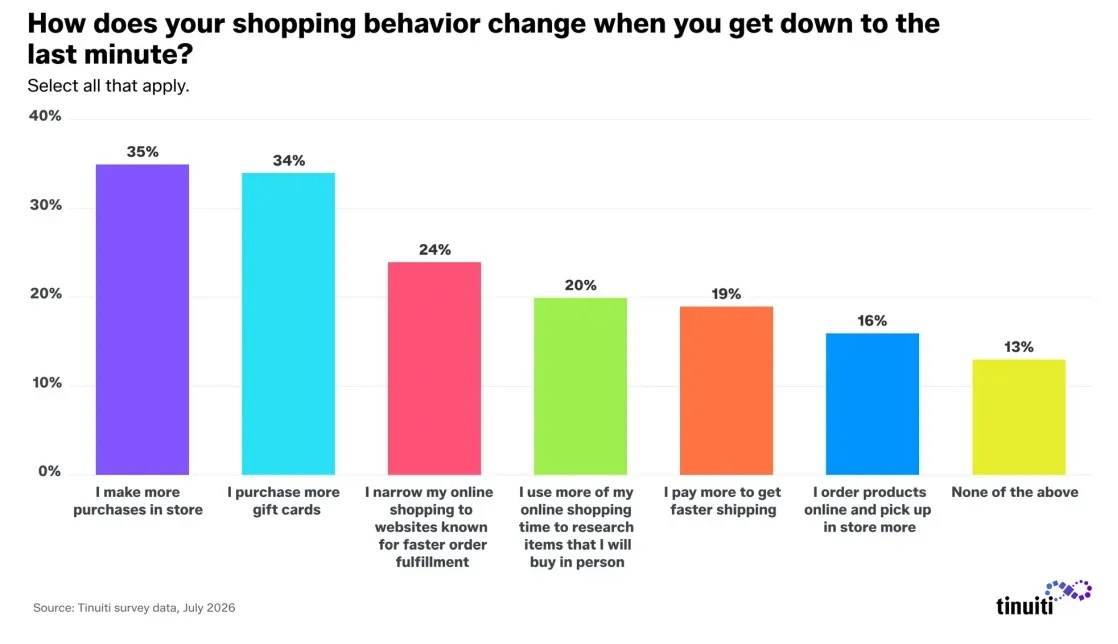
Overall, BOPIS (buy online, pick up in store) is becoming more important but is still not the top choice for last-minute shopping. Consumers prefer to go directly to physical stores or choose gift cards to reduce delivery risk.
For brands, this means clearly displaying estimated delivery dates, order deadlines and expedited shipping fees late in the holiday season, so consumers can quickly judge whether an item will arrive in time.
5. Post-Holiday Consumption Trends
5.1 Discounts, Gift Cards and Compensatory Purchases Drive Spending
Holiday shopping does not stop when Christmas ends. The survey shows that nearly half of holiday shoppers plan to keep shopping after the holidays to take advantage of year-end sales and discounts; 36% plan to spend gift cards received during the holidays, and 25% plan to buy discounted holiday decorations after the season.
Post-holiday gift demand is also visible. 21% of consumers plan to buy gifts for people they will not see until after the holidays — rising to 36% for Gen Z. Another 21% plan to buy items they had hoped to receive but did not get during the holidays, a demand that may further extend the post-holiday shopping cycle.
New Year's resolutions will also create demand. 12% of respondents say New Year's plans affect their post-holiday shopping, including 20% of Gen Z. Brands tied to "New Year, New You" trends such as health and fitness have a chance to gain attention early as consumers build new habits.

5.2 The Holiday Spending Cycle Is Extending from Q4 into January
Overall, the period after Christmas through January — often called "Q5" — is becoming an important spending window for some categories. Consumers continue hunting year-end discounts, use gift cards, buy post-holiday markdowns, and generate new demand through replenishment, returns and exchanges, missed gifts and New Year's plans.
Across the full 2026 holiday shopping cycle, several consumer behavior shifts stand out:
- Online shopping expectations are higher than offline: 31% of consumers plan to increase online shopping.
- Shopping is starting earlier: 17% of consumers have already started buying holiday gifts, but Black Friday through Cyber Monday remains the key concentrated window.
- Discovery channels are more diverse: in-store displays still account for 45%, while search engines, social media and online platforms each reach 33%-37%.
- Price, free shipping and promotions remain the most important purchase factors, at 74%, 67% and 61% respectively.
- Age groups diverge clearly: younger consumers rely more on social media, streaming, influencers and fast delivery, while older consumers depend more on stores, search engines, Amazon and gift cards.
For brands and sellers, this means 2026 holiday planning cannot revolve around a single promotional day. Consumers may start discovering products in August, September or even earlier, compare in October and November, concentrate purchases from Black Friday to Cyber Monday, and enter last-minute shopping in December. After Christmas, discounts, gift cards, replenishment and New Year's plans bring new demand.
Holiday marketing is therefore evolving from a shopping moment concentrated at the end of Q4 into a continuous consumption cycle spanning more time and connecting more channels.
Frequently Asked Questions
What is the overall outlook for US holiday spending in 2026?
Overall moderate growth: 27% of holiday shoppers expect to spend more on gifts, 23% less, and 50% about the same; online expectations are more positive, with 31% planning to increase online shopping.
What are the key holiday shopping moments this year?
Shopping is starting earlier — 17% of consumers have already begun buying gifts, but Thanksgiving through Cyber Monday remains the core window, with 29% planning to start then; Black Friday falls on November 27.
How do age groups differ in shopping channels?
Gen Z relies more on social media (55%), streaming (33%), influencers and fast delivery; baby boomers rely more on in-store displays (48%), search engines (40%), Amazon (66%) and gift cards (63%).
Back to news list